Apr 20, 2015

Of Reading and Documentation in Development Sector

In every field of endeavor, the one who reaches the pinnacle will be found to have built upon the knowledge and experience of someone who preceded him. People in development sector feel obliged to submit report to donor organization with complete focus on grants. There are suggestions from the expensive government project reports that end up just gathering dust on a shelf in India. Thousands, of reports on policy, poverty and development issues are released each year world wide. A lot of recommendations, solutions and findings are keep on piling in a PDF version. The citation of paper doesn't imply that it has been read. Even the reader looked only at downloads and citations to gauge the use of these report. The key question that comes in mind: Who will ever read them?

Even world bank is pondering over this question (Which World Bank reports are widely read ?) Recent findings suggest my fears:


The researchers contribute to their discipline's knowledge with the deep optimism of shaping decision making ability of the practitioners. However, practitioners very rarely read articles published in peer-reviewed journals. One of the ironies of development sector has been that researchers have envied practitioners and practitioners have undermined the academia. Practitioners label reports as long, boring, incomprehensible jargon and full of technical language.

Knowledge sharing takes place in many different settings—through seminars, presentations, & blogs. The slow pace and complexity of poverty, gender and development meant that the blog is more for enthusiasts and casual readers. In the eyes of detractors, such trend leads to the art of reading the superficial books and blogs. But we must look for a long term vision and expanding the base of readers. The popular and easy will boost people's reading list, among many of whom are working with limited knowledge even with high literacy levels. These readers can gradually move towards domain oriented journals. Journals are essentials but have limited ability for the academia to engage people with all types of opinion ranging from stupid to innovative. There is an urgent need to promote new ways to increase impact and spread of the knowledge.

Why don't we see more books/films/blogs like this coming out of development? They do exist; we just have to seek them out and make them available for more than handful of readers. Practical knowledge is interdisciplinary, not confined to narrow pockets of domain. There is an open-access movement in access of journals that will allow practitioners from reading and understanding them. Through books, op-ed and blogs, there can be reach to a wider set of practitioners, journalists, citizens, students, entrepreneurs, civil society experts and other development actors. Even the most talented thinkers have to reach masses for shaping future's public debates or influencing policies. A good idea need to see the light of day. Only the eloquence and wisdom of the author's passion in writing can lead to the compelling reach of such idea for mass audience.

Still and all, most books published in the private market have few readers, most music fails to reach an audience, and most movies fail. Any popular medium of spreading knowledge like blog is no exception of this rule. However, marvelous an idea may be – cannot, on their own change very much the widespread believes. Working in isolation strongly holds back progressive causes and the effectiveness of enlightened minds and seasoned practitioners.

I have written a blog on list of books and list of movies aimed to spread basic ideas to all rather than tiny size of the intended audience. One can look for Understanding Economic Development Reading List by Chief Economic Adviser to the Government of India, Arvind Subramanian. Suggested Blogs for those who are still interested :

Academician : Illa Patnaik, Swaminomics, Ajay Shah. Tyler Cowen.
Practitioners :  Arvind Kumar, PMRDF.

Apr 10, 2015

Naive Advices to Rural Manager

Men often become what they believe themselves to be. If I believe I cannot do something, it makes me incapable of doing it. But when I believe I can, then I acquire the ability to do it even if I didn't have it in the beginning. --- Mahatma Gandhi

I am driven by personal ambition and not selfless heroism. I look for perpetual returns with a field work backing up degree in rural management. Few Rural Managers work towards the development of the rural folks. One doesn't has to be born and brought up in villages and small towns. Empathy and an open mind will do the job really well.

Trial at the field level is much engagement and full of frustration for any rural manager while it's occurring, and and many can vouch for this. When the task is accomplished, the afterglow does provide a lot of satisfaction. Self Motivation is the key to perform in whatever condition one is placed into. As an rural manager, I learned that the most important thing is to listen and to be willing to re-invent himself. There are 11 pointers taken from the job :

1- Can you listen? No one has managed people by silencing dissent. So, Listen with patience all their complaints, stories and sorrow. That is the most important thing one can do for the people. In this field, one can't solve most of the problems of the people. But listening to the grievances, difficulties with empathy is one compassionate act that can be done by an individual. This part of job is non-glamorous but it is essential.

2- Please demonstrable integrity; Half baked promises will erode the trust and words really spread like the plague. That is why never promise what one can't deliver. Even a person managing the ground force of sales team will agree on this.

3- A man's intelligence can be tested by his ability to explain complex problems in simple terms. Rural Manager must be able to establish communication with target audience by giving examples from their real life and surroundings; I did learn few metaphors such as describing seed capital as a seed of plant and investment as nurturing tree. Simple example makes sense and attracts attention rather than pouring of bookish knowledge.

4- Go Vernacular, Become “Unprofessional” in interaction with people. Most of us can become functionally able of speaking/listening a new language but rarely are those who are intellectually and emotionally excel in new language. It is better to live with the community for a brief period of time. And, one should never presume to lecture people about the choices they make. They make that choice with a lot of thought.

5- Have a Positive Attitude and communicate daily with your mentor and seniors. It is not necessary to like the people, but you must learn to enjoy the interaction itself. It is necessary to behave calmly and reply on the merit of comment not be overshadowed prestige of the person.  Hence, oft-heard "that's the way I do work" is simply not good to survive in this field. There is need of agile mind and quick action in every task performed.

6-  Few times, we have a tendency to dismiss or marginalize people we don’t understand. To live and work in rural areas requires special qualities: open dialogue, an interest in culture, a sense of curiosity and an immense energy. Baggage of degree from premier institute holds no good here. Basic knowledge of festivals, songs, taboos i.e. local culture will be a great asset and often can be used to break the ice between strangers (mostly women) at the field. It is needless to emphasize upon to be gender & caste sensitive.

7- I always assume that knowledge will always help in seeing the broader prospective. One must always know in detail the relationships among agro-climatic conditions, natural resources, production systems, markets and livelihoods of rural people. Theoretically valid ideas taught in close classrooms might not be implemented exactly as planned and that practices that worked well in one region might not be replicated to other domains. Even one is well versed with a degree, expanding into areas where they have no competence, do harm, not good. Don't confuse ignorance with originality

8- Leadership happens when people grow and develop under you. Give credit where it is deserved; a public acknowledgement wins more faith rather than monetary compensation. Any leadership with underdeveloped teams lack strong internal sounding individuals for ideas and concerns. In order to succeed, one must be given a chance to fail. That can one do for helping the subordinates.

9- Respect is something, a rural manager has to have. Preach what you practice. Example is little controversial but never drink in public and then lecture about ban on alcohol. Wrong person however close need not to be defended, sympathized with and passed over in silence. It will lead to conflicts whose resolution depends only on your respect as neutral. Unless one is just without becoming aggressive and dominant to every body, one will never gain respect.

10- Don't watch the trees too closely, you will miss seeing the forest; One must not work in haste in drawing conclusion on seeing few individuals, lookout for the ecosystem which nourishes/exploits them. Simply, it means so involved with the details of a situation that he loses sight of the larger issue. The reverse may also happen true where one can't see the trees for the forest. It is also possible to be too broad (macro) when looking at a situation. Never act like top managers who make impossible demands from subordinates. It will only suggest a complete unfamiliarity with the complexities of a project.

11- The best of rural manager is to knew when to be theoretical and when not to be. Education is not just about reading. It also involves observing and wearing down the nonsense through rational responses. The success depend on the capacity for hard work and an enormous interest in meeting people and absorbing whatever they conveyed. It takes a village… to make a rural manager.

The challenge as a rural manager is to develop high level skills through education and on-the-job experience that cannot be outsourced. Am I cut to be a working in rural areas ? If not, I must develop few qualities that can help others. I think that's any rural manager's responsibility really, to make world a better place and to leave the rural India an easier place to work for; to set foundations and guide with advice to upcoming managers and entrepreneurs. Somehow the belief that your work is helping improve someone's life by an iota makes it all worthwhile.But at the end of the day I think job is very simple: to work with the best of our ability, so that to inspire younger generation to excel given standards. Legacy, Career are of utmost important but life is about loving what you do and doing what you love, while gaining fresh pleasure, wisdom and maturity.

Mar 21, 2015

GoI circular on FPO

GoI had issued a circular for Farmers producer organisations (FPOs) on 11th February 2014. As per circular, FPOs may be treated at par with cooperatives and other quasi- governmental institutions providing common service facilities to the farmers/users in Rashtriya Krishi vikas yojana (RKVY). Please check the circular on the government website.

Mar 12, 2015

Young Professional @ Odisha Livelihood Mission--- 2

Young Professional (YP) is a short-term work opportunity (three years) to experience development and gain exposure to government operations and policies. Panchayati Raj Department, Odisha is the agency in implementing National Rural Livelihood Mission (NRLM) program delivery and interface in Odisha serving to the marginalized section of the population. While the government is always reluctant to share or de-valuate power to the community, NRLM has tried to build sustainable community institutions at the Panchayat level. YPs served either at the district or block administration level. In simpler words, YP is just another name of Management Trainee in a government agency doing the contractual job without any power.

Why I joined Odisha Livelihood Mission?  One can't have the right to voice their disappointments unless one understands the functionality of the government. I have also considered the government as the biggest development agency in India. Hence, it is of utmost importance to understand governance in India. Corporate look into so many people as consumers and term them as "Bottom of Pyramid". In contrast, OLM was trying to build the capacity of people without throwing away subsidized schemes. These are a few of the many reasons why I was able to work with the state.

I always wanted to have a balance between theoretical and practical work. It is different to know the name of something and actually observe or experience it. A course in rural management doesn't offer subjects that make their students ‘understand’ the rural people. Even with a bit of knowledge acquired in the college, I was looking for a job as a practitioner, not a professor. I have written in detail on this topic previously Young Professional @ Odisha Livelihood Mission.

I worked as YP in OLM from April 2013 to January 2014. This work gave me the opportunity to work with the Government and the community jointly. This time span has good, bad, and even ugly moments. I was able to show true character and talent by taking up the challenge and worked with a zeal to learn.

The Good:

The single strongest predictor of group effectiveness is the amount of help that peers do to each other. A bunch of YPs was no exception to the rules. Our workplace has qualified men and women with diverse professional, academic and cultural backgrounds from educational institutions like TISS, NIRD, IIFM, XIMB, XISS, & KSRM recruited as YPs. Diversity is reflected in our inclusive environment that embraces all sorts of values and ideas; The best part was having people who weren't sycophants rooting for their college brand rather than cross-engaging for new collaborations.

I developed a decent understanding of the Odiya language. Rural India has been transformed over the last half-century, the people are freer and filled with aspirations, but the old values continue to extract a toll. What I saw was how significantly social networks influence people’s decision-making. There are people out there who didn't get the option to graduate or study in regional medium alone but have sound knowledge on development. There is also a feeling of powerlessness and an inability to make themselves heard in the corridors of power.

To counter the dimension of being voiceless, I tried to reach out to many people as possible and ask tons of questions. Typically, people don’t like to be questioned, but it is essential to engage with people in a friendly way and listen to them. It's a bit like an investigative journalist checking narratives of the beneficiaries, non - beneficiaries, government officials, & elected representatives. I was also lucky to interact with Dr. H.K. Pradhan, a senior faculty member of XLRI spearheading an initiative in Balasore. And yes, there are government officials doing honest work in a thankless job.

Our simple assumptions like simplifying schemes, running awareness campaigns, and make the public goods widely available were critically assessed in the light of new evidence. There is a wide gap between community, market, and government - like coordination problems and inequality in access to power and information. I was able to oversee as an insider working of Indira Awas Yojana, Mo Kudia, Mo Pokhari, MGNREGS, Gramsabha, social audit of government programs, and Panchayat administration. I learned two lessons on public policy and government.

1. Efficiency isn’t always the goal of policy as one has to give attention to social and cultural complexity. Public policy requires fairness, which doesn't lend to the most efficient policy but is virtuous nonetheless.

2. Government is anything but well-tuned, acting coherently and consistently in pursuit of a well-defined set of objectives, captured by a single social welfare function. Government is a crucible of interest groups, rather than a black box of noble intentions.

The Bad:

It is necessary to get the first step right to reach the solution to the problem. Once the first step is incorrect and the entire problem gets way too complicated. A sharp glance at the old schemes of the central and state government shows more tweaking rather than the innovative design of new programs. Hence, the failure rate of the government is of utmost high. There was quite a low emphasis on Monitoring & Evaluation (M&E) job. Too much emphasis was given on the framework of old government programs; I have written in detail on this topic: Why Government Schemes Fail? and Why Government Schemes Fail? -2

Even Lord Curzon has complained, "Round and Round like the .... revolutions of the earth goes file after file in the bureaucratic & daily dance, stately, solemn, sure and slow". Guidelines, plans, programs, or projects tend to be neatly prepared for submission, but agencies and individuals return to business as usual once it comes to implementation. Meetings are important as they give part of the thought process of various govt departments. But in short, there was more time wasted in aligning the process than measuring qualitative results.

The Nobel Prize-winning behavioral economist Daniel Kahneman has established that unfairness is a larger motivator for action than fairness. YPs were assigned different salaries even with the same job profile that is unfair and the issue was pushed down under carpets. It puts the act of cohesion and coordination in jeopardy.

The Ugly:

Appointing consultants on a contractual basis, instead of employees on the rolls, is a common practice adopted by companies but most NGOs as well. It is done to evade the responsibility of providing PF benefits which are mandatory under labor law. And, this was done to YPs by an agency working on behalf of a government department.

The problem isn't that the staff don't contribute, it's that the official who takes feedback don't think of themselves as ignorant enough to learn something new in face of new proofs. Even officials are not cold to the problems faced by them but they are more tied in the tight framework of government norms. But, it was indeed a hierarchical institution with less space given to honest feedback as it may undermine the authority and raise questions. Shooting from the hip in presentation is an easy way out, but do dig a little deeper people will tell the real stories on the field. There was more tendency of risk aversion than performance in the staff.

Why I left Odisha Livelihood Mission? Personal reason to work close to home was the primary factor behind the decision. Due to being vocal initially, a lot of negative images was build in the central team. Yet, lack of mentorship, no clarity on the role, and working without powers was a frustrating experience to be as professional. Hence, the scope to take any concrete work was quite limited. I am a work in progress and don't want to stifle in starting phase of my career. Hence, I shifted to another grass-roots organization.

Mar 2, 2015

Funding Mechanism for Farmer Producer Organizations

Progressing with the previous discussion of FPO: Public Policy & Value Chain Development, we are looking into credit accessibility of Farmer Producer Organizations (FPOs). India is successful despite the government because of the entrepreneurship, energy, and ingenuity of the Indian people. Our smallholder farmers are not marginal recipients of charity but instead customer entrepreneurs. Even with the linking of small and marginal farmers to FPOs, the question of reliable and affordable sources of financing for the capital requirement of Infrastructure and operation always lingers for the farmers. There is always the issue of access to credit in the agrarian sector. There are many donor agencies like International foundations, Domestic Foundations, Business related CSR, and government schemes for financing credit to FPOs. But the search for such donors with big pockets for solving the problem is elusive and unsustainable way.

Formal financial institutions (FIs) are wary of lending to these bodies, largely due to the absence of collective land titles (for collateralization) and credit tools for customer assessment. For a nascent FPO, FIs require collateral and three-year balance sheets. That sums up the tragedy of the situation. There are proposed funds coming up for the support of FPOs. I am enlisting them as per my knowledge. But the author is not legally liable for the information provided here. This is collected through various online sources and workshops.

Grants:

1. Equity Guarantee Fund- The Equity Grant Fund enables eligible FPOs to receive a grant equivalent in amount to the equity contribution of their shareholder members in the FPO, thus enhancing the overall capital base of the FPO. The Scheme shall address eligible FPOs, which have paid up capital not exceeding Rs. 30 lahks as of the date of application. Equity Grant shall be a cash infusion equivalent to the amount of shareholder equity in the FPO subject to a cap of Rs. 10 lahks per FPO.

2. Sectoral Fund- Under NRLM, there is a provision that states agencies (SRLM) develop partnerships with major government programmes and build synergies to address different dimensions of poverty and deprivation. Every Producer Organization will receive Sectoral Fund (SF) up to Rs. 20 Lac, in two installments, to invest in value chain development for livelihood promotion. The first installment of SF will be given to the PO within two months of its formation (mini. 100 members) with minimum paperwork. This installment can be up to Rs. 5 Lac. On completion of the establishment phase, the PO will submit a Business Strategy Report to RRLP together with a requisition for release of next installment. The second installment can go up to a maximum of Rs. 15 lac.

Loan Product:

1. With Collateral- NABARD has created a dedicated corpus to provide loans to producer organizations. Yet, NABARD demands FPO to offer collateral (15%of  loan amount) at the interest rate of 10.5~ 11.5 %. There is a clear impact on collateral offered over the interest rate. Since most of the FPOs are formed by small and marginal farmers, they lack collateral.

2. Without Collateral- Interest computation on daily principal outstanding of drawn amount. Flexibility to use the funds only when required thereby leading to huge savings on interest cost of (13.5-14.5) %. The agency (mostly NBFC) will take a 1% upfront processing fee and SFAC will charge 0.85% of guarantor fees. There is NO collateral required for the loan. Through the setting up of the Credit Guarantee Fund, SFAC has enabled a few credit institutions to provide collateral-free credit to FPOs by minimizing their lending risks in respect of loans not exceeding Rs. 100.00 lakhs. The lending institution shall be bound to comply with such directions as SFAC may deem fit to issue from time to time, for facilitating recoveries of the guaranteed account or safeguarding its interest as a guarantor.

3. Warehouse Receipt Finance- This seems a feasible option when the working capital crunch is over. FPO is targeting commodities like Soya bean, Cotton (including bales), Mustard, Maize, Wheat, Sugar, Paddy, Cashew, Castor, Chilli, and Turmeric only.

All the grant and loan appraisal process is designed with various parameters depending on the policies of FIs. They all focus on the high representation of women in membership as well as in the Board of Directors(BoDs). Hence, a small step in the direction of empowerment of women is taken. Thus enabling women's participation increases the chance of wealth ownership and leadership. Structural discrimination against Women, Dalits, and Adivasis can be prevented by giving voices in such forums linking business with social change.

It is the right time for financial institutions to come up with innovative financial products targeted at FPOs. On banking parameters, if not adopted, FPO policy can't be scaled up. The transformation of FPO can only happen in phases from Grants, Soft loans, and then linkage to mainstream banking institutions. Banking institutions and the rural community have a lot of ground to cover for implementing FPO policy on the ground. Even with so much of changing policies, the FPO model deserves tax holidays in the initial years to build surplus and reserves. The taxation policy of FPO (30%), insurance, and, license issues are more complex topics to be discussed in upcoming blog posts.

Sources ---

Jan 13, 2015

FPO: Public Policy & Value Chain Development

A basic concept can be read here:2014 - Year of Farmer Producer Organizations (FPOs) before going further ahead in this topic.

Public Policy: There is always so much talk on FDI in retail, so it seems a good state to channel the same money for farmers’ producers’ cooperatives and ensure they get good margins and market access. The government of India (GoI) already invest Rs 275,000 crore in an agricultural subsidy budget that is constantly touted and needs to be unpacked. Who is the real beneficiary of these subsidies, farmers, or seeds, fertilizer manufacturers, and agricultural banks? That is where good public policy comes into play.

The government of India (GoI) is promoting the concept of Farmer Producer Organizations going in the right step to engage and adapt agriculture to the market system. The primary objective of the collective mobilization of farmers into FPOs is to enhance the production, productivity, and profitability of especially small farmers in the country. FPO will be positioned as a gateway agency between the farmers and markets. The complete Policy and Process Guidelines for Farmer Producer Organizations; is a good framework. FPO policy will give auxiliary advantages like women’s empowerment.

Policy guidelines are the first step but we need awareness of this novel concept among a diverse range of stakeholders: the farming community, State Governments, Banks and other financial institutions, Civil society organizations, the media, and elected representatives of the people. Policies that impede the growth of FPOs, such as APMC laws, tenancy provisions, cold storage, etc. must be amended with changing times.

Value Chain Development: With the below diagram, we see how Value Chain is different from Supply Chain.


 Value chain development interventions focus on improving business operations and relationships (even contractual) at the level of primary producers, processors, and other actors in the chain. Production, harvesting, procurement, grading, pooling, handling, marketing, selling, and exporting of primary produce comes under the scope of the value chain. It can also include preserving, drying, distilling, brewing, venting, canning, and packaging the produce of its members.

Value chain analysis starts with mapping the volume of products, the number of people engaged, the geographical flow of products, and value at different levels of value chains. The supply and demand side of the business can be understood with the result of analysis only. Only then, we can start with the business planning of the enterprise. All the members of FPO are primarily farmers only but we need to build their capacities on trading, accounting, and hoarding practices over time. Farmer Producer Organizations can only result in more sustainable and better-performing business plans when farmers have a good understanding of value chain systems.

FPOs are nee steps towards organizations having higher financial autonomy and lesser government subsidy. Possibly the biggest failure of GoI is the promotion and formation of good organizations in the agriculture sector. Let us look for the big question in the livelihood sector: Is a full-fledged value chain development project through FPO the best way to bring about development? If not, then what is an alternative!

Jan 9, 2015

Development Sector

Salary is one of the most critical components of a human resources strategy even in development sector. It is unreal, and perhaps even unfair, to expect that a development professional is going to do good to society at a loss to himself. This path has produced few rare exceptional people, but its not a sustainable way of growth. I think job anywhere is very simple; to work with the best of our ability, and inspire younger generation to excel given standards. Compensation, Experience , Commitment and Skill set creates the Job Profile. But there is always huge gap between supply and demand in development sector. The reason is below:

Nov 19, 2014

World Toilet Day

“Civilization is the distance we put between ourselves and our own excreta.” - Brian Aldiss, The Dark Light Years

Indians are strange creatures as when we think of skills we are obsessed with IITs; when we think of health care we can scarcely think beyond doctors. At present, generally, the Indian has cleaning to the household level but is apathetic to the community where he lives. Even governments typically overspend on very high on expensive machines used in healthcare, at the expense of public goods such as community toilets, sewer pipes, low cost sanitary napkins etc. Despite of bad image of World bank among left in India, they will also agree with their suggestion of increased spendings of government on sanitation issue. India has already popular PPP model of community toilets and washroom in Sulabh Shauchalya.

November 19th is celebrated as the World Toilet Day to raise awareness on the use of toilet, sanitation and clean water. I was invited to a primary school with Block Development Officer (BDO) on this day a year before. I learn a lot on five ways for washing hands; waterborne disease & clean water for safe drinking. Ganjam district is ill-famous for open defecation in the whole Odisha. This was directed towards giving children information on area of water, sanitation and hygiene (WASH).

Knowledge alone though is not enough; it has to be complemented by actions to implement the most basic rules for prevention. Using evidence to guide massive social investment is crucial to ensuring the efficient use of limited resources. As per research of  JPAL in Kenya , there is little evidence on whether existing water quality, sanitation, and hygiene (WASH) interventions lead to lasting improvements in children’s health, growth and development and whether nutrition programs are more effective when combined with WASH interventions.

Government machinery has funds under Individual Household Latrine (IHHL) for construction of toilets at household level. It requires 10% fund by the household while 90% are given by government in three phases. And, sanitation is seen only as seen as construction of new toilets without thinking about water facilities and waste management. Power builds consensus like nothing else. There is no democratic discussion in government meetings. Even infeasible orders are taken without looking either on the quality of construction work or utility to end user to achieve targets. Unless government at municipal doesn't think on the line of Reduce-Reuse-Recycle, there will be huge waste dumped without proper process.

There is quite little thinking on policy level on solid and liquid waste management, awareness regarding toilet usage, water storage, hand washing practices and acceptability of the total idea of sanitation. India really need a large social campaign to make people aware, working with them and explaining things of private hygiene to them. The reason is that sanitation is primarily a behavioural issue, to be undertaken by community and household for their own good. The role of government is only to facilitate this positive change by providing incentives and solution oriented approach in assisting people.  Government is trying to work with children in schools and mothers through health clinics to educate them about hygiene behaviour. Such education initiative can help change behaviour and hygiene practices, it is a super slow process. The sanitation problem is so drastic and urgent that policies need to be set in place to drive behavioural change. There is need to have social norms regarding sanitation. Government need to listen the wise words of Samuel Johnson: "People need to be reminded more often than they need to be instructed.”

Nov 15, 2014

2014 - Year of Farmer Producer Organizations (FPOs)

I always remember the words of Chinese Premier Deng Xiaoping - "It doesn't matter whether the cat is black or white, as long as it catches mice." So, now NGOs and the government are finally coming to the phase of acceptance of market forces in the development sector. The cooperative movement is already a failure except for a few notable examples. The government has never managed to manage any scheme efficiently. The government is partnering with various professional organizations for setting up a new institution in the country - Farmers Producer Company (FPC) / Farmer Producer Organizations (FPO). The legal framework is ready under the Companies Act. According to this new law, only farmer–producers can be members of the FPC and the farmer members themselves will manage this company. It takes care of the flaws in the cooperative societies but has also borrowed the strengths of the corporate companies.


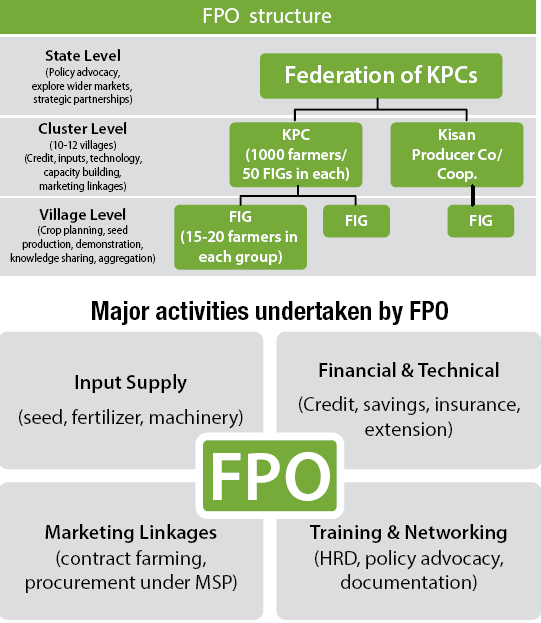
FPO/FPC will be dominating future debates on livelihood and its success depends on the implementation and design of the program. Pieces of evidence will come for pros and cons of such initiative, no matter how reliable, have to be interpreted. Interpretations can differ and do differ, and such differences account for an explanation. That is a future full of possibilities. I will be updating this space related to FPO. The chart will give an overview of the FPO structure and purpose. It is a bit late to post here but the Calendar year 2014 is declared as the “Year of Farmer Producer Organizations (FPOs)”.

Oct 31, 2014

Annual General Meeting of UAPCL

Udaipur Agro Producer Company Limited, UAPCL, is a social-enterprise company focused on strengthening the livelihoods of the community. The organization was registered on June 29, 2010. The company’s main concentration is building the surrounding community through direct collaboration. The company is comprised of 1635 members. Each member is a local farmer mostly small and marginal who owns a share of the company.

UAPCL Annual General Meeting
Share Certificate Distribution
ACCESS Team with UAPCL Board of Directors
ACCESS Development Services is working in the area of livelihood with FPOs (Farmer Producer Orgainzation). Here is a glimpse of Annual General Meeting organized by one such - UAPCL attended by 700 members. Here we see smallholder farmers not as marginal recipients of charity instead as customer entrepreneurs. I will be updating more on FPOs in this space.

Sep 24, 2014

Consultant Job

Let me start with a joke: I have a MBA degree and wanna be consultant in future! Does any development organization need consultant ? Yes, they do. Analyst and Consultant form a core area of jobs created in the knowledge economy. Whereas a leader can win people over in an instant due to oration and vision, an analyst can do same with the technical wizardry. But the most over-hyped and over-mocked job belongs to consultant.  Consultants are not brought on to be unbiased. They are hired to confirm a particular bias. There is a popular one line gag on consultant - "If you are not a part of the solution, there's good money to be made in prolonging the problem."

There is always a lot of conferences and consultations on ‘labour rights’ that continue to be held at five star hotels — which for one are known to underpay their employees — without a hint of irony. It may seem wrong, pragmatic, or indecisive and confused? Take your pick. A consultant must focus on collecting data and analyzing the results but always look to field for the ground movements.


Complete package of Engineering and MBA is gradually becoming a shortcut route of becoming a consultant in India. The advantages of a MBA degree isn't really only classroom learning – a degree is easily achievable and online courses available if one wants, it's hidden in network effects and networking opportunities: government, private companies, civil society, and donor agencies. Our classmates are going to form major career networks moving forward. One may say the same for most fields.  I always take words of Henry Mintzberg with bitter pill - "The trouble with ‘management’ education is that it is business education, and leaves a distorted impression of management” & “Not much will to manage, but plenty of zest for business”. ( Managers Not MBAs: A hard look at the soft practice of managing and management development)

I haven't taken MBA degree for fast tracking progress of salary, but to seek a clear relation on public policy and rural India. I want to live as decent human being who engage himself and others substantially in an inclusive development. I don't want to be limited in a AC room as consultant, waiting to speak to field staff who would have nothing but contempt in seeing a waste of financial resource as sunk cost in me. Someone once told me a mantra- "What is difficult in field training will make life easy in a consultant job." I do hope to become a better consultant one day myself.

Aug 29, 2014

The Volunteer


It's fine to have people working in development sector with degrees from the elite colleges. But even if they are good at statistics and analysis, they cannot be decision-makers without a grassroots experience. Problem with today’s education is that it doesn't have any relationship to the real world. Images get reinforced over time with newspaper, media and cinema. Innocent Villagers, Shrewd Businessmen, Corrupt bureaucracy and Selfish Political leaders become stereotype. Such perception breaks with each intersection and performance in the field.

Living in the village with no other business but to follow native life in the present day of social media buzz and 24*7 connectivity seems bizarre. But one sees the traditions, ceremonies and transactions over and over again. What it leaves one with temporary chaos in the beginning. In addition to fostering mutual understanding, perpetually curiosity and occasionally confused volunteer start to see the way of living of a community. A long stint of month or more can create less-domineering, nonjudgmental volunteers who are not obsessed with the pursuit of the emotional highs (and photo ops) of the altruism they put effort for. It makes volunteer adapt to the culture, to be flexible, relevant and realistic. Even the long times doesn't alter you so much as the people you meet along the way shape you.

True development cannot be heralded without market, intellectual, cultural and scholarly liberalization. The very best mainstream economists/scientists were the radical youths who questioned authority when they were students. An exposure visit can give limited understanding but volunteerism/internship grooms a different aspect of personality. Our rural side has survived without services of elite rich throughout ages. They will survive but a youth needs mixed dose of idealism, activism and academic expertise. The volunteer takes more than what it gives. Giving back can be very good for career. Most of the volunteer/interns end up as consultants in international aid and lending agencies. The opportunity cost seems high in short run but benefits individual and people around.

Some people volunteer because they want mentoring while other for the sake of different experience. Even volunteer experiences work for different people from frustrating to fascinating, depending on their goals and organization policy. Too often, volunteers are thought of as a “nice to have” rather than a “necessary” resource, and facilitating agency / NGO's apply little or no rigor to evaluate their impact. They are not paid due to budget constraint and then termed as priceless instead of unpaid . Communities can mold the young as future change agents and social entrepreneurs.

There are bigger question involved in the business of volunteerism. Is voluntarism ultimately about the fulfillment of the volunteers themselves, not necessarily what they bring to the local communities they visit ? Does an intervention of a volunteer make the cure worse than disease ? Are volunteers/interns unpaid contract labors of NGOs?  An article in Onion (6-Day Visit To Rural African Village Completely Changes Woman’s Facebook Profile Picture) mocks volunteers with a hard hitting sense of humor. There is also a  good article showing the narcissistic side of global volunteerism. The articles are full of sarcasm but looking on the positive side, it reminded me of a line by Professor Peter Hayes: "Live somewhere else, on the terms of the people who live there, for six months. It will change your life."

Aug 17, 2014

Cash Transfer Scheme

Government is so agile to implement e-governance solutions for improving its tax collection system, but prefers neolithic methods for cash disbursal decisive and purposeful governance.  The government’s budget is a mess. Subsidies have been overdone and not properly targeted. In the current year, total subsidies will be over 2.8 trillion rupees. Instead of making the direct cash transfer, all of the welfare scheme has been turned into a giant procurement exercise. That is why, Reserve Bank of India governor Raghuram Rajan made a strong pitch for direct cash transfers to the poor, saying this would help reduce corruption by breaking the "cycle of dependence".

A cash transfer is a development project stripped of any active management costs, and its performance tracks the success or failure of the individual recipient. Cash Transfers are examples of certain transfer payments include welfare (financial aid), social security, and government making subsidies for certain businesses (firms)  into the bank accounts of beneficiaries, cutting out intermediaries. Cash Transfers: Sorting Through the Hype puts a balanced light on the whole exercise.

There are pros and cons attached with Cash transfers. The popular myth that “the poor people don't know what is good for them”. That, in my opinion, is derogatory. We should stop worrying that the poor are going to spend (or “waste”) their transfer income on alcohol and tobacco. They aren’t. They might buy some chocolate, though. A proper study can has been done : Do the Poor Waste Transfers on Booze and Cigarettes? No. The cash transfer is taking away discretion of government officials on taxpayers money spent in the name of welfare. Financial cost of social justice and their concerns that the poor can't be taken without economic freedom. See more at Whose money is it anyway? to understand another side of the debate on welfare state and individual freedom.

There are two major school of thoughts under Direct Cash Transfer (DCT) - CCT and UCT.  Unconditional Cash Transfer (UCTs) consist of cash grants with means testing to ensure funds go to the intended recipients, but without extra requirements on recipient behavior. The downside of unconditional cash transfer (UCT) is in distributing money without increasing the productivity and skills of labour force in rural india. But we can see the partial benefit of Economic Freedom associated with the “distributor of welfare funds”  through cash transfer. The economic freedom to utilize funds in an unique and distinct way by each beneficiary is an important aspect of building better markets.

CCT always have strings attached of a certain criteria to be fulfilled.  The advocates of CCT pitch for skill transfer with money as sustainable economic growth cannot be created by simply distributing money or as some economists like to put it by “dropping money from a helicopter”. Both CCTs and UCTs require the beneficiaries to be linked to bank and can access financial services. But there are reports that the government’s much-hyped Direct Benefit Transfer programme has hit a roadblock. In the current situation, the current electronic system and incentives are structured, the agent has not been incentivized to offer financial services.

Only government can offer reach to the poor that is effective nature of state. while market will always go for person with better information and resources for efficiency. The social transfers together with the wages and pensions form the Government- to -person (G2P) payments. Could this ecosystem of government-to-person (G2P) payments enable or lead to financial inclusion? Even working one year  in the field of development, the blatant  truth is, I don't have solid clue of what the poor need. Sometimes its cash, sometimes skills. As per me,  DCT can serve both purpose as a seed capital in a business for enterprising individual or as a social safety net of whole family

Jul 29, 2014

Why Government Schemes Fail? - 2

India's new prime minister, Narendra Modi's slogan "minimum government, maximum governance" is a serious goal. Its implementation on the grass root level will be tried and tested, and that is where most of the government’s schemes fail. There are myriad of difficulties faced by the government in properly designing and implementing of the public policy. Continuing from the previous article: 'Why Government Schemes Fail?', I will examine same question from another angles.

Design: Let us start with the design of the government schemes. What works well in the coastal belt of Kerala is unlikely to work in the Terai region of Uttar Pradesh, or for that matter, hilly lands of Garhwal. Hence, one size fits all schemes must be carefully reviewed. There is a strong tendency for planners to go in for prestige and grand projects. Through this they can leave monuments to their activity, even if defunct. The visibility is major emphasis than actual proposed work. It helps every level of government machinery to justify their budget and performance.

Most of the schemes even if redesigned are just shadows of past failed schemes. Reforms exclusively based on experience of the past suffer from another infirmity as it fails to factor in the innovations and transformations of the relevant sector. Any government scheme should be designed as a business model with incentives built for each stakeholder. Illegality in transaction slowly crumbles the scheme merely from the fact that the policy was not right from the beginning.

Involvement and Access: More democracy is required in making designs for the schemes! Currently, the only option left with people is of protest on bad implementation of schemes. There must be welcome and feel comfortable atmosphere for non-IAS experts with domain expertise to operate in regulatory bodies and government-run organisations. Advisers from the NGO sector like CRHP, Pradan had helped in shaping better schemes in the past.

Our huge ignorance to understand the functioning of the government and the local institutions is barrier to good governance. There is need for proper channel so that people can mobilize for effective political action to prevent mismanagement of resources by government. A small time broker and politician help poor to navigate a system that gives them so little access. Hence, the complex web of subsidy, entitlements and schemes in a very well intention-ed and well designed scheme hit the rock solid wall of the gargantuan system.

Political Interference: Government ministers announces huge scheme without having a concrete plan. It ends up similar to attempting to build a house without a blueprint. Political parties whenever come to power in central/state governments try to adopt developmental plans to suit their manifestos. This jeopardizes the future trajectory and intensity of implementation of schemes. The politically motivated decisions of fund allocation led by the relationship of the incumbent State and Central governments hinder welfare schemes and huge investments. Most of the time old developmental projects are either ignored or rejected in favour of new political discourse. There is always misalignment between financing of scheme, condition of economy and political campaign promises. This can go hugely wrong and ours current government current fight to hold Fiscal Deficit is one such glaring example. When a subsidy scheme becomes a non-viable financially, no matter how well-meaning, it must be restructured or abolished to extinction.

Planning and Coordination: Planning is done in ad-hoc manner and is generally a mere collection of schemes. This is an under-discussed problem of coordination between the intra- and inter- government departments. The right word is Convergence. Each scheme is being implemented by the respective department in isolation. Hence, it is imperative to make directed and organized efforts for converging such schemes. Convergence improves the deliver-ability of the benefits and services, it also gives better value to the public money. The Perpetuating Problem of Coordination will explain intrinsic details of the issue. The lack of reliable data for planning also causes failure of policies. With many of our allocations in schemes based on unreliable secondary data. There is dire need for collecting relevant data pertinent to all sectors, updating it periodically and planning and allocating financial and human resources based on this data. A new type of public good, Open data banks must be promoted among public, among companies and other non-government entities. With the availability of massive, publicly-held data sets in machine-readable “liquid” form can unlock the potential to spur innovation in all sectors.

Regulating and Implementation: How do you prevent abuse? The old mindset in which the command and control instinct dominated with emphasis to restrict, stifle, manipulate, control and micro-manage with new rule curb both private and public sector.A rule of thumb for efficiency standards is that they should be 'tough' but not panic inducing'. Time and space is needed to react with new initiatives.  There is heavy scrutiny of projects in implementation when problem arises due to poor design. The problem of implementation without clearly defined or sometimes ill-defined rules creates a lot of room for manipulation and hence make it inconsistent and unfair.

If you want to understand how the government functions, you must understand movement of files. All decisions in the government are taken on files through office orders. If projects/ schemes are not moving on file, then all public policy is waste. No person in bureaucracy want to take a decision without any political support and risk career damage. It eventually led to stalled projects and failure of the scheme.

Budgeting and Auditing: Why Development is considered in Terms of Expenditure Done? I am still looking for answers. Nobody is looking for the quality in government and this task has been left to the social audit. The delay in releasing funds and issuing UC (Utilization certificate) deter all the stakeholders involved in the scheme. There is always difference between fund requirement and allotment in budget. Even unimaginative funds required are just 10% increment of previous year budget. Take any scheme in government, the usual discussion in meetings revolves around Target Chase. There is a new idea floating to move away from the usual bureaucratic jargon of “targeting numbers” to “targeting names".

90 per cent of the government is now covered by the CAG, but much of this has been done through executive orders, not an amendment in our act. All PPPs, Panchayati raj institutions and NGOs getting government funding under need to be brought under the ambit of CAG. Due to no expertise on this topic, I will refrain from putting more words on the blogpost.

We are seeing that NRHM, NREGA & NRLM are delivering better result than government departments. Mission mode is working relatively well in the new order of scheme design. Accountability mechanisms and examples of government schemes that worked are quite low in our country. We need solid discussion on reports to understanding of the policies, scope, mechanisms, drivers and benefits of various schemes across different states and sectors. Everything has an expiry date, no matter how good their past performances. There is logic for having a provision to discard schemes once their utility is over. All programmes need strong monitoring, which is absent most of the times. A separate blog post is entirely needed to showcase the problem of monitoring and evaluation. That is a another story for another time.

Jul 9, 2014

Another Poverty Line

“By means of deep meditation and magical power it may be possible to sleep on fire, but it is impossible to sleep with an empty stomach in a situation of poverty.” - Thiruvalluvar (50 B.C.)

New poverty line has been redrawn by Rangarajan Committee. It is Rs 32 for rural India and Rs 47 for urban India. The earlier poverty line figure was Rs 27 for rural India and Rs 33 for Urban India.  Columnist T N Ninan has given us glimpse on the approach taken for defining poverty line - "The Rangarajan committee, set up two years ago to take a fresh look at poverty issues, has according to a newspaper report recommended a radically new way of deciding who is officially poor. New in India, that is, because the approach that the committee has reportedly recommended is already in practice in the US and Europe: poverty is defined, not as an absolute level of income, but relative to the average levels of income. The US says all those whose income is 40 per cent or less than the average (median, not mean) are poor; Europe is more generous, and puts the cut-off at 60 per cent of the median income."

The findings of the Rangarajan panel report on poverty estimates states that three out of 10 people in India are poor. 30% are poor but who are they? They are not uniform and homogeneous group as projected by media. Even those who are just above poverty line may fall below this due to vulnerable situations. I assume that new holy trilogy of social security {National Pension System (NPS), National Rural Livelihoods Mission (NRLM) and Food Security Bill} can provide safety net to many. Proper estimation, identification and targeting of poor for schemes are the real challenges in getting schemes implemented properly in our country

 Commenting on the poverty line will be like muddling on the pile of deadwood. I came to conclusion now that everyone believes what they want to. So depending on one's ideology, poverty in India has reduced or increased. Statistics can only be a tool for managers or policymakers. Perceptions, Meaning and Utility are the reality checks used by consumers and voters. Even in ours democracy, extreme poverty is not much relevant to the median voter belonging to middle class now. That is the state of affairs.

The cascading effect of increase in prices of petroleum products on inflation and a high fiscal deficit is a matter of serious concern. Upcoming budget must have tough measures to deal with forecasting of poor monsoon and high prices of petroleum due to Iraq war. I hope to see end of Subsidy Raj in Modi led central government and there are talks of abolishing planning commission. To what extent the government will be able to undertake reforms will depend on how far the NDA is willing to go.

Jul 7, 2014

Xavier University

Odisha Chief Minister Naveen Patnaik has inaugurated the Xavier University on the outskirts of the Capital city of Bhubaneswar. Report by Odisha Diary bureau can be read in the weblink here. Congratulations to my Alma Mater for inauguration of "The Xavier University, Bhubaneswar" !

Jun 30, 2014

Best Advice Ever !

I have landed a new job with Access Development Services at Udaipur. That is new news.


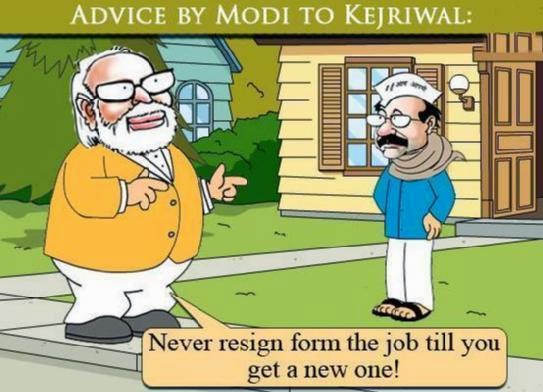
So why this cartoon? I broke 'Golden Rule of Quitting' that is quoted by NaMo above in the cartoon. I have also came to believe that nobody should quit job before working at least one year in a new sector. I faced a short term of unemployment as a rural manager. In retrospection, decision of quitting seems courageous but was made in haste and ill advise. The courage of moment is often over-rated and short of time, the word perhaps should be temperament to show mental strength. The days without job are long and depressing. Many rounds of interviews, rejection and low salary offers were part of this phase. It is easier said to follow own conviction than done. Not only the market treat a labour without job with low packages offering, cost of living in NCR dents the saving. Job hunt also showed me skewed distribution of opportunities, of how inequalities, relevant experience, and notion like 'merit' get created.

New job offer came as a great beacon light of hope and luck to me. Beacon that shines on the tower at milestone may not be the one we envision in the start of journey. I am more dedicated and cautious towards career now. But if you are looking this short tragedy with a tinge of heroism that is missing in my scene. I would have not sustained momentum without continuous support of my friends and colleagues. My mentors turned out to be what prof dumbledore was to harry. Help will always be given at Hogwarts to those who ask for it.

Every disadvantage has its advantage, but it is taken only by those willing to look within and introspect. I accept my fault of ignorance and arrogance. Few days of unemployment taught much on strategy of job search, need of vibrant professional network and solid knowledge. By nature I am a very self-critical person. It has its profits and losses. I was in stage of self doubt with constant rejection. Lately, I converted this crisis much to enrich self awareness and life skills. I am confident but will never take own skills for granted for now. Moral of the Story: There is no Moral in the Story! Just words of an underachiever.

“‎Hold yourself responsible for a higher standard than anybody else expects of you. Never excuse yourself. Never pity yourself. Be a hard master to yourself-and be lenient to everybody else.” ― Henry Ward Beecher

May 31, 2014

Takeaway from KIVA

"I don't believe in charity; I believe in solidarity. Charity is vertical, so it's humiliating. It goes from top to bottom. Solidarity is horizontal. It respects others and learns from others. I have a lot to learn from other people." ~ Eduardo Galeano

Have you heard of KIVA? Kiva is a non-profit micro-lending organization that connects folks around the world who need a loan with people who are willing to make those loans, often at $25 increments. I am giving my tiny share, and one year of my activity with KIVA has been completed. I have contributed an amount of 25 $ as a loan ten times from June 2013 to May 2014. Hence, a total fund of 250 $ is acting as seed money on KIVA today. 100 $ has been returned by the borrowers and is in circulation again as a revolving fund. I too got a 50 $ bonus for introducing two friends on KIVA. You may doubt what I say, but you will believe what I do with the proof. This is my Profile at KIVA for verification purposes. The complete process of giving loans and reimbursement through KIVA is explained in a previous blog post.

The poor and the weakest fight harder for survival, so they deserve more. They need only a little money to set up a business that can dramatically improve their standard of living. This is where commercial capital isn't willing or able to serve.  Milaap in India and KIVA are one of the best start-up ideas I've seen. They are doing humanitarian work and completely benefiting all the stakeholders.

The smallest deed is better than the greatest intention. - John Burroughs

WHY I LOAN? I loan because I can. Only capacity and compassion are required to do these small acts. I have a certain degree of positive bias towards the marginalised. As a traveler and native of India, I have seen poverty firsthand and am committed to making the world a better place for all. Ground truth and lived realities are the collateral benefits of becoming a 'Rural Manager'. Aid is a nice but not sustainable way to help people. I had questioned myself a great deal, and this made me choose a suitable way to help others.

Some people claim to become altruistic only when their own self is fulfilled. It's a pity that they lack a sense of “enough”. Often, the ‘successful’ tend to become ‘insulated’ from society as they get richer and more successful. Most of them gradually generate an attitude of apathy and contempt towards the poor because the relationship is based upon social and economic inequality. In return, among other things, they always endure the relentless stares of poverty. An unequal society with a majority lacking even basic amenities will tend to create undesirable reactions. I am not asking that everyone should have the same, but that each must have enough. So, such 'successful' persons need to awaken the inner conscience for empathy. To whom much is given, of him will much be required.

"If not us, who? If not now, when? " - A slogan given by Czech University Students in Prague, Nov. 1989.

I always recite this slogan in the hours of doubt. I am not seeking political activism and grand relief work from the readers. A small, sustainable, and efficient way to change the world is better than fascination with a big project. I usually follow a simple mantra, ie, matters of lifestyle: One can change, provided the will is there. I will ask readers to help people through small loans. Doing this doesn't require much time, absence from office for volunteering, and doesn't deplete one much of the hard hard-earned money. I agree that it is neither glamorous nor can it make one famous, but it will make a difference to someone!

*I am planning to start contributing to another platform called Rang De with a new job.

May 29, 2014

Capacity Building Venture

The word “training” is a cliched jargon used in the corporates. There is another buzz word used for this in the development sector. That word is termed as "Capacity Building" (CB) and it is an endless process. Development professionals and government believe that we have this new knowledge, and we need to teach communities how to do stuff. I have seen such special sessions focused on  inauguration, speech and a boring lecture where participants are waiting for the lunch. Most of the times, workshop had limited interaction and few important questions raised regarding project. The worse use of "CB" word doesn't stop there. It has extended into "empowerment" for poor or "sensitization" for educated government officials.

Makarand Sahasrabuddhe has aptly said: “Many a time capacity building is just a euphemism for cramming 30 people in a room for a few days and trying to kill them with power-points and flipcharts and group work (that also takes care of the ‘participation’).”

I am not saying that all capacity building exercise must be discarded. Building capacity is a slow process and learning must be judged on certain criteria. Adults usually learn new knowledge through application and experience. They don't modify the way of their work if they are being lectured as they're in a high school classroom.

This reminds me of the Hungry Man book, “If a man is hungry, don't give him a fish … organise a workshop … agree on clear objectives … don’t forget advocacy … participation … and the sustainable mainstreaming of gender.”

May 18, 2014

Migration Series - 1

One can't escape the plight of migrant labour while living in the KBK region. Most of the semi-skilled workers migrate to Gujarat. A large chunk of the migrants from Western Odisha are landless labourers and marginal farmers, not having access to any kind of irrigation facilities. They are employed in the brick-kilns of Andhra Pradesh, Tamil Nadu, and Uttar Pradesh.

Nuakhai is the festival of eating newly-harvested paddy, celebrated in September or October. That is the season of mass migration of the seasonal workers. The recruiter and transporter are paid a commission by the brick kiln owner. The recruitment of labour in the brick kilns is done with the help of contractors/local sardars. They offer a token amount of a thousand as first-time advance to these people and confirmation of going for migrants. A family of three or four usually migrates after receiving the full payment, ranging from Rs. 30,000-40,000. It is quite normal for the labourers to use the cash advances to settle their debts at home. Brick Kiln owner, Labour Department, Railway staff, and local contractors are linked in a long chain of this distress migration.

Brick manufacturing is back-breaking work, involves children, and there are no fixed hours. The work is built on the exploitation of casual labour, and these seasonal workers have no benefits or insurance. Torture, exploitation, and denial of wages are common practices at Brick Kilns. Force is used to discipline the worker and silence the grievances. The loss of entitlements at home and the loss of recognition of their rights at work are major issues faced by the seasonal workers. Child labour is a rampant practice in such places. I will only say that when the lives of children are at stake, even a cold-hearted person can be a silent witness.

Given that a lot of tough physical work is required amid extreme conditions, the wage rates are usually low, such that when the workers return home with small sums of cash after 6-8 months. Their advances are adjusted against a token wage rate, so that they are still in debt to the contractors or kiln owners, whom they have to repay the next season. Deceptive practices such as fraudulent bookkeeping in wage payments are prevalent. The migrants return in April and May each year for the next agricultural season.

Along with the drought, problems such as rural unemployment, non-industrialization, growth of population, and rapid deforestation are faced by the KBK region. Migration-prone blocks of Balangir district are namely Belpada, Khaprakhol, Titiligrah, Patanagarh, Muribahal, Bongomunda, Saintala, and Tureikela. I started routine discussions with locals and government officials in the district. I personally thank PMRDF fellow Raj Gupta for providing this short documentary on migration in Odisha and Sudhir Mishra, a local journalist, for blog inputs.


Why are NREGA & NRLM not suitable substitutes for stopping migration? Even if a ousehold is involved in 150 days of work in the year, only 22,000 is generated from this work in NREGA. That too is a delayed payment, unlike a one-time direct cash settlement by the contractor. Even producer companies formed under NRLM can augment income up to Rs. 5000-7000. Even under ideal conditions of convergence, there is a loss of income that somehow must be fulfilled to stop such distress migration. There is also provision under the Bonded Labour System Abolition Act of 1976, and under the modified scheme, the rehabilitation grants to the extent of Rs. 20,000/- per bonded laborer are provided. The brick kiln industry works in a largely unregulated manner in the informal sector. Overall, there is inadequate information on the nexus of various actors involved and the economics of this modern slavery like practice. We need more documentation to ensure a better grasp of the grassroots-level situation and stories like Why India's brick kiln workers live like slaves' By Humphrey Hawksley are missing in our mainstream media. I have not even mentioned health and gender issues in the article. We need huge advocacy and social movements to make the lives of workers better. Whenever the masses unite with one voice, leaders listen!

May 8, 2014

A Comic take on Migration!

Migration is the least developed aspect of globalization today as compared to foreign investment or fair trade. Here is a funny take on migrant and natural citizens in middle east society by comic Maz Jobrani, an Iranian-American and a founding member of the Axis of Evil Comedy Tour. Have a great weekend and more posts will be coming on migration issue!

May 6, 2014

Rural Awareness Campaign

Communication for development (C4D) in rural areas employs the same tools as MNCs but serves different purposes. Rural Communication campaign for awarding people by NGO/Government has to put forward facts before target audiences to appraise them with the Government scheme or value of Sanitation, Education, Health, Gender, and Public Rights. The use of ICT like government department websites in distributing information is limited to English rather than the local language. Searching and cutting parts of data from the website is not easy for villagers using telephone-based connectivity.

Mid-media activities such as street plays, mobile vans, screening of video films, and even Puppet shows are used as a medium of communication in rural areas. Hoarding, Wall paintings & danglers in the local vernacular language also form an important part of the marketing communication strategies. They come at a low cost and the visibility is high, and so is the stickiness. Booklets, Pamphlets, and newsletters can be used in states with high literacy rates like Kerala. Social media such as Community Radio can be beneficial and accelerate the awareness of people. Community halls, Anganwadi centers, Health sub-centers, Schools, Bus-stops, Tea-stalls, dhabas, Dharamsalas (public rest-houses), and Private houses(with permission)are the centers for the campaign.

Motivational messages in Rural Odisha (Renga Village, Koraput District)

Sensitisation Program on NRLM at Bibhutia Village, Surada Block, Ganjam District.


'Ghanta Mrudunga' is the form of art used here for the Information, education, and communication (IEC) campaign. This type of event is helpful in channelizing the information on NRLM through street play sessions. Partner agency has developed IEC material for creating awareness among the public as well as the targeted communities. This event has its drawback. It was organized in interior hamlet but no emphasis was given on the convenient time of women or daily wage laborers etc. The notable absence of the target group in accessing the information on the importance of livelihood shows the approach of the government machinery. I was only monitoring the campaign as it unfolds. The low turnout was a professional failure.

I am still searching for outstanding examples concerning the use of communication to support rural development. Grievance redressal and social audit are good examples of the two-way communication campaign. Against this rural background in Odisha, the question of rural development quickly gives way to a broader, even more, difficult question: Does communication matter for good governance? How can one-way communication enhance good governance, participation, and transparency? How do grassroots democracies evolve, and how do they grow stronger?

May 1, 2014

Happy Labor Day !

I always put greater faith in “I am a Nigerian widow with 10 million dollars to give you” emails than in corporate presentation or welfare scheme of government. Its funny to talk to very successful youths championing mythical 'free markets' who inside the bubble tend to assume, instinctively, that what is good for them is good for India. But, a conversation with government employee becomes mental assault who has 'natural' tendency to micromanage, curb, control, and even stifle any entrepreneurial activity leading to loss of their power. I am wandering between these two worlds currently.

A World Bank consultant (Shouvik Mitra) once informally remarked that “Subsidies are like toothpaste coming out of the tube, once it is out, it is virtually impossible to put it back”. Hence, any decision on subsidy must emerge from public policy rather than political appeasement. Lately, I found so many voices among these mentioned group opposing Food Security Bill but having a dead silence on 7th Pay Commission. They talk on fiscal austerity but aren't ready to swallow pills taken their own prescriptions. No hypocrisy is too great when economic and financial elites are obliged to defend their interest.

Be not distracted by passage above, celebrate public holiday officially known as Labor Day or International Workers' Day. Wish you dignity, satisfaction and safety in your working environment.
*I don't own the picture or its copyrights. I have use it for information purpose.

Apr 29, 2014

PRI Capacity Building & Training

The 73rd and 74th Constitutional Amendments ushered in the Panchayati Raj in India. Panchayati Raj Institution(PRI) is a three-tier system in the state with elected bodies at the village, block, and district levels. The rural mathematics of the vote in the Panchayat election has become highly political in nature due to the channeling of government scheme funds through the PRI. There are voices emerging on corruption at this basic level. Budget expenditure for Panchayat elections runs in lakhs for no other reason. Many gram pradhans are becoming powerful by grabbing resources meant for the welfare of the people whom they represent. In my opinion, PRI has embarked on one thing for sure, i.e., decentralized benefits of corruption. Looking on the positive side, infrastructure development and money are returning to the village economy through this arrangement. PRI has brought more of a sense of local governance to rural India.

“Power tends to corrupt, and absolute power corrupts absolutely. Great men are almost always bad men.” - Lord Acton, English historian and moralist of the 19th century.

“All power corrupts, but some must govern.” - John le Carre, British ex-intelligence officer and novelist of the 20th century.y

Gram Panchayat is getting involved in planning, nd execution, and monitoring of the various public schemes. There is a lot of funding available at the local level with the decentralization of power through PRI. A barely educated Gram Pradhan is dealing with huge amounts of money under social security schemes, namely MGNREGS, BRGF, TFC, SFC, Indira Awas Yojna, etc. PRI representatives are not professionals, but the only voices of the people. Management takes money and people. With such an amount of cash flow, processes can't be left on the shoulders of either overburdened representatives or volunteers in the committees. It is more necessary to invest in human resources with knowledge and raise the amount of operational expenses (salary). A Nayab Sarpanch gets less than a thousand rupees per month as an honorarium in Odisha. How can such a person give full attention to the responsibilities?

The idea of a managed transition of power in Panchayati Raj is still a delusion unless leaders of the community emerge by breaking conservative, male-supporting, social structures. Most of the elected representatives of PRIs are illiterate and semi-literate. They have negligible knowledge about PRIs and no operational skills required for local governance. Capacity building and training (CB&T), particularly in an ongoing process that focuses on creating new leaders, especially women, and knowledge transfer at the grassroots level of democracy

I have attended a few training sessions in conference halls given to PRI members. Most of the training focuses largely on content and has a minimal focus on the mode of delivery. Lectures/PowerPoint presentation mode of training is theoretically sound, but may not be absorbed well by an audience with a bare minimum literacy amid rural backgrounds. Research has demonstrated that adults learn six to seven times more through practice and feedback than through lectures, yet far too many capacity-building programs consist of classroom sessions or self-study modules. I don't have backing on any conclusive study, but exposure visits and study tours conducted have more recipients in rural India.

There is a growing focus on the development of a two-tier cadre of resource persons, i.e., the master resource persons and district/ block resource persons. Most of the states provide short-duration inputs (5-15 days) with the help of State Institutes of Rural Development (SIRD). Training sessions in government workshops have created a pool of trainers, but the quality is lacking in the human resources. There is no long-term systematic strategy employed by the government. The lack of a strong monitoring and evaluation system for training doesn't help in assessing the impact of such training. The effective establishment of PRIs as a strong node for local governance remains a distant reality until these gaps are filled properly. Organizations (NROs) such as Tripti(Odisha), SERP (AP), Jeevika (Bihar), and Kudumbashree (Kerala) are slowly grooming the leaders through Livelihood Mission who have sufficient knowledge of PRI & various other schemes.

Kaushik Basu (in October 2013): "Overall economic growth is important, but the poor should not have to wait until its benefits trickle down to them; with the right anti-poverty policies, governments can encourage trickle-up growth as well." Building public institutions is a slow process, with frequent regression, but over time, PRI will become a strong, inclusive, and democratic institution in the spirit of the constitutional amendment. Progress is a painstaking task, and we have a long way to go!